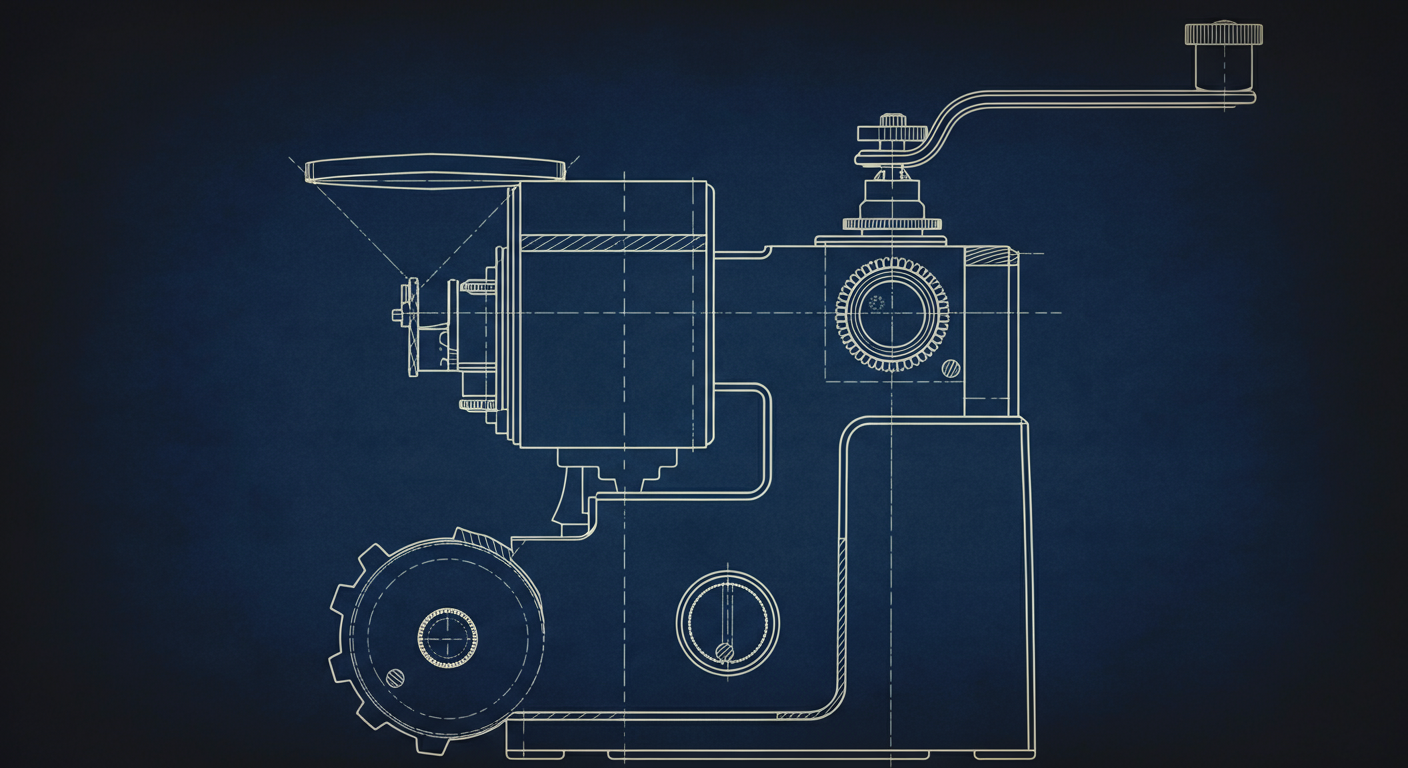
The Baratza Encore is not a revelation. It is a baseline. A minimum viable product for those seeking an electric burr grinder without significant financial outlay. Its reputation often exceeds its actual capabilities. Expect compromise. Expect plastic. Expect maintenance. It is a machine of acceptable function, burdened by cost-driven design decisions. It will produce grounds. It will not excel. It represents the lowest entry point into acceptable coffee grinding. Nothing more.
Spec Audit
| Specification | Detail | Audit Note |
|---|---|---|
| Grinding Mechanism | Conical Burr | Standard for this segment. |
| Burr Material | M3 Steel Conical Burrs | Acceptable hardness. Adequate edge retention for home use. |
| Grind Settings | 40 Stepped Settings | Sufficient for general filtered methods. Lacks micro-adjustments. |
| Motor Type | DC Motor | Standard. 450 RPM burr speed. Reduced heat generation. |
| Drive Train | Belt-driven, Plastic Gear | Reduces noise. Plastic gear is a critical durability concern. |
| Hopper Capacity | ~8 oz (227g) | Standard for home use. Functionality is adequate. |
| Grounds Bin Capacity | ~5 oz (142g) | Polycarbonate construction. Static prone. |
| Chassis Material | ABS Plastic | Lightweight. Lacks structural rigidity of metal. Cost-effective. |
| Dimensions (W x D x H) | 4.7 x 6.3 x 13.8 inches (12 x 16 x 35 cm) | Compact footprint. Suitable for most countertops. |
| Weight | 7 lbs (3.1 kg) | Moderate. Not heavy. Reflects plastic construction. |
| Intended Use | Drip, French Press, AeroPress, Pour Over | Particle distribution suitable for these methods. Not espresso. |
| Power | 120V AC, 70W | Standard household current. Low power consumption. |
Pros & Cons (Audit Findings)
Acceptable Aspects
- **Particle Uniformity:** Achieves acceptable particle distribution for common filtered brewing methods. Not exceptional. Sufficient for its intended purpose.
- **Operational Simplicity:** Controls are minimal. Power switch. Grind adjustment collar. Low barrier to entry.
- **Parts Availability:** Baratza maintains a robust spare parts program. Self-repair is feasible. This mitigates some design weaknesses.
- **Footprint:** Relatively compact. Does not dominate counter space.
- **Reduced Burr Speed:** 450 RPM minimizes heat transfer to grounds. Preserves volatile compounds. Acceptable.
Deficient Aspects
- **Construction Material:** Predominantly ABS plastic chassis. Lacks tactile quality. Raises durability concerns. Not a robust structure.
- **Espresso Suitability:** Grind range is too coarse for proper espresso extraction. Particle distribution is too wide. Unacceptable for espresso.
- **Static Retention:** Significant static charge generation. Grounds cling to chute. Grounds scatter during dispensing. Requires constant cleaning. Inefficient.
- **Grind Retention:** Measurable amount of coffee grounds remains in the grinding chamber and chute after use. Wastes coffee. Affects dose consistency.
- **Grind Adjustment Steps:** Settings are wide. Lacks fine-tuning capability. Limits optimization for specific coffee beans or subtle brew adjustments.
- **Noise Profile:** Motor is audible. Not discreet. Interrupts morning tranquility.
- **Drive Gear Material:** Internal drive gear is plastic. A known failure point. Anticipate replacement.
The 3-Axis Deep Dive
1. Mass (Build Quality)
The Encore’s mass profile is dictated by its material composition. It is predominantly plastic. Not solid. Not premium. The chassis is ABS. The hopper is polycarbonate. The grounds bin is also polycarbonate. This selection prioritizes manufacturing cost reduction. It does not prioritize structural rigidity. It does not maximize longevity without intervention.
The M3 steel conical burrs are acceptable. Their geometry and hardness are adequate for home grinding. However, their carrier is plastic. This introduces potential for burr wobble, though minimal in most units. The internal motor is a direct current unit. Acceptable for its rated duty cycle. The overall weight, 3.1 kg, is moderate. It is not indicative of substantial internal components or dense structural materials.
This grinder does not set a benchmark for material science. It functions. It relies on the consumer’s acceptance of plastic as a primary structural element. This is a common compromise in its price bracket. But it remains a compromise. The tactile experience is that of a consumer appliance. Not a precision instrument.
2. Ratio (Value)
The Encore’s primary appeal is its accessible cost. For this expenditure, one acquires an electrically powered conical burr grinder. It fundamentally surpasses the performance of blade grinders. This is a low bar. The particle distribution, while not exceptional, is consistently superior to its blade-based alternatives. This provides a measurable improvement in brew quality for filtered coffee methods.
Its performance aligns with its cost, but only for specific brew methods. For immersion and pour-over, the value proposition holds. For methods requiring fine, precise adjustments, such as espresso, its value diminishes to zero. The inherent limitations are direct consequences of its price segment. One pays for fundamental functionality. Not for luxury. Not for precision beyond a rudimentary level. The ratio of performance to cost is acceptable for the beginner. For the discerning user, it is inadequate.
Baratza’s parts program enhances the long-term value. The ability to replace failed components mitigates the initial investment. This extends the service life beyond what its initial material specification might suggest. This is a critical factor in its overall value assessment. It acknowledges component fragility and offers a solution. This solution, however, implies anticipated failure.
3. Time (Workflow)
Operational design is direct. An intuitive on/off switch. A rotating collar for grind size adjustment. This simplicity reduces the initial learning curve. It saves initial setup time. However, daily operation introduces several inefficiencies that consume time.
Static electricity generation is significant. Grounds cling to the plastic chute. They adhere to the grounds bin. This necessitates frequent cleaning. A brush is often required. Every use. This adds minutes to the morning ritual. Grind retention is also present within the grinding chamber and exit chute. Residual grounds can be substantial. This requires purging or manual agitation to clear. This wastes coffee. It introduces inconsistency if not managed. This consumes time.
The grind speed is moderate. It is neither excessively slow, nor remarkably fast. A typical 20g dose for a pour-over takes approximately 20-30 seconds. This is acceptable. Hopper design is functional, not elegant. The overall workflow does not streamline the morning ritual. It merely executes a necessary task with predictable friction points. It is not efficient. It is merely functional.
The Flaw Investigation: Plastic Gear Durability
The primary vulnerability of the Baratza Encore is its internal drive gear. It is constructed from plastic, specifically a Delrin (acetal) copolymer. This material choice is not an oversight. It is a calculated engineering compromise. It prioritizes manufacturing economy. It demonstrably sacrifices enduring reliability.
Delrin possesses specific mechanical properties. It offers good wear resistance. It has a low coefficient of friction. However, its ultimate tensile strength is finite. Its fatigue limit is real. The conical burrs resist rotation significantly when grinding hard coffee beans. This resistance translates directly into substantial torque exerted upon the motor shaft. This torque is then transmitted directly through the plastic drive gear. This is the critical juncture.
Over time, or under specific stress conditions, the gear teeth deform. They chip. They strip. This is not an anomalous event. It is a well-documented, predictable failure mode for this grinder. Baratza acknowledges this by supplying replacement gears. This demonstrates an awareness of the inherent design limitation. It does not negate the limitation itself. The user is expected to replace this component. This is not a matter of “if” the gear will fail. It is a matter of “when”.
Prolonged grinding sessions or grinding excessively oily, hard beans can accelerate this degradation. Friction within the burrs generates heat. This heat can transfer to the burr carrier and, subsequently, the plastic gear. Elevated temperatures reduce the plastic’s mechanical strength. This makes it more susceptible to deformation and stripping under load. This is a thermal stability issue inherent to the material and application.
This design choice reduces the unit’s initial cost. It shifts the burden of durability. It imposes a requirement for periodic user maintenance. The motor is often robust enough to outlast the gear it drives. This indicates an imbalance in component durability within the drive train. It is acceptable for a consumer-grade appliance with a replaceable part. It is not acceptable for a robust precision instrument.
Comparison: Baratza Encore vs. Capresso Infinity
To contextualize the Encore’s performance and design, a comparison with the Capresso Infinity is instructive. Both occupy a similar entry-level price segment. Both utilize conical burr sets. Both are primarily intended for filtered brewing methods.
The Capresso Infinity often exhibits superior static management. Grounds retention can be lower. This results in a cleaner, less frustrating workflow. The Infinity’s burrs operate at a slower RPM, typically around 400 RPM. This can lead to marginally less heat generation during grinding. However, it also results in a slower grinding process. Particle distribution on the Capresso Infinity is generally acceptable for drip, but some analyses suggest the Encore offers slightly better consistency for certain grind sizes within its optimal range.
Mechanically, the Infinity’s internal gear system appears more robust. The documented instances of stripped gears are significantly fewer compared to the Baratza Encore. This suggests a more durable power transmission design. The Encore’s modularity and user-serviceable plastic gear are a double-edged sword. It allows for repair, but highlights a systemic weakness. The Infinity, while not immune to failure, does not have such a prominent, universally acknowledged point of mechanical fragility.
Both are acceptable baseline grinders. Neither is a benchmark for advanced grinding technology. The Capresso Infinity might offer a more reliable long-term mechanical structure. This reliability comes at the expense of slight grinding speed and potentially minor differences in grind consistency for specific brew methods. The choice hinges on priorities: ease of repair and marginally better peak consistency (Encore), or perceived greater long-term mechanical reliability and cleaner operation (Infinity).
Final Judgment
The Baratza Encore is an entry-level electric conical burr grinder. It is functional. It produces coffee grounds demonstrably superior to blade mills. This is its core utility. Its design philosophy prioritizes cost-effectiveness and accessibility. It does not prioritize engineering robustness. It does not prioritize absolute precision. It does not prioritize longevity without user intervention.
The plastic drive gear is a known, significant component failure point. This requires user awareness and potential maintenance. Particle distribution is acceptable for immersion and pour-over methods. It is fundamentally unsuitable for espresso. It generates static. It retains grounds. These are inefficiencies. It is a utilitarian tool. It is not a premium appliance. It serves its market segment adequately. No more. Its high global demand score is a reflection of its market positioning and price point, not inherent excellence or ground-breaking design. It is acceptable. With substantial caveats. Users must manage expectations accordingly.
Baratza Encore Conical Burr Coffee Grinder
Audited by The Chief Auditor
*Commission earned