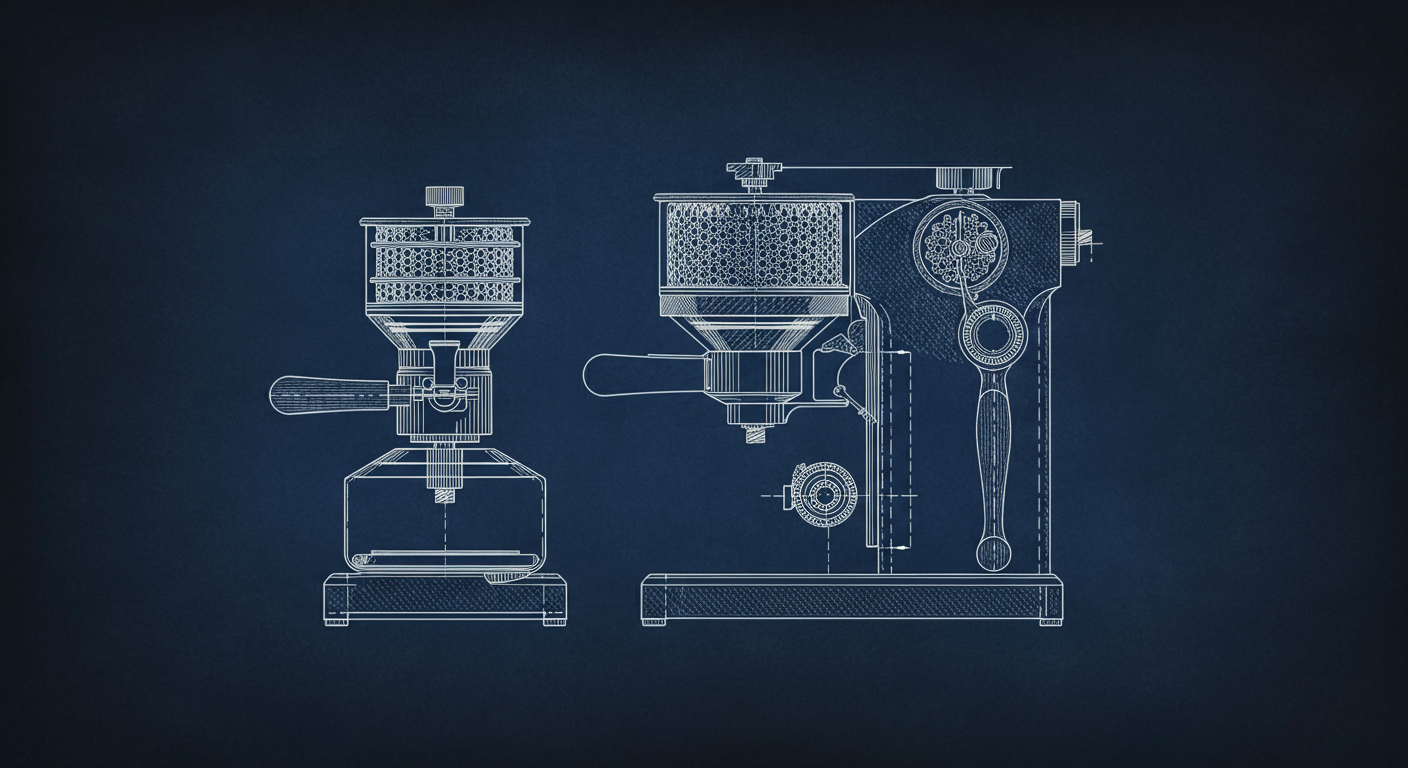
The Fellow Ode Brew Grinder Gen 2. Another iteration in the perpetual quest for adequate home grinding. The market clamors. We remain unconvinced. This machine purports to address prior shortcomings. It attempts, with moderate success, to deliver consistent particle distribution for non-espresso applications. It is not revolutionary. It is merely a refinement. An acknowledgment of past deficiencies, packaged as progress. Do not mistake improved performance for engineering brilliance. It is acceptable for its stated purpose. Barely.
Spec Audit
| Parameter | Specification | Auditor’s Note |
|---|---|---|
| Model | Fellow Ode Brew Grinder Gen 2 | Second generation. Implies first was insufficient. |
| Burr Type | 64mm Flat Burrs (Gen 2 Brew Burrs) | Optimized for pour-over, drip, French press. Marketing term: “Gen 2 Brew Burrs”. |
| Grind Adjustment Steps | 31+ (Gen 2 offers finer capabilities than Gen 1) | Discrete steps. Limits micro-adjustment. |
| Grind Range | Coarse to Fine-Brew (Not espresso capable) | Explicitly excludes fine espresso particle distribution. Understandable. |
| Motor | PID-controlled Brushless DC Motor | Consistent torque. Necessary for burr speed stability. |
| Hopper Capacity | ~100g (Single Dose) | Design choice. Limits batch grinding efficiency. |
| Retention | Low (Advertised: ~0.1g) | Expected for single-dose grinders. Critical for consistency. |
| Anti-Static Technology | Yes (Ionizer) | Addresses a primary failure point of the Gen 1. Essential. |
| Construction Materials | Aluminum body, plastic base, stainless steel burrs | Acceptable material choices. Plastic is a compromise. |
| Dimensions (H x W x D) | 27.5 cm x 10.5 cm x 24.1 cm (11.5″ x 4.9″ x 9.5″) | Compact footprint. Suitable for confined spaces. |
| Weight | 4.5 kg (10 lbs) | Provides stability during operation. Acceptable mass. |
| Price (MSRP) | ~$345 USD (Variable) | Premium cost for a dedicated brew grinder. Subject to market fluctuations. |
Auditor’s Findings: Acceptable Features
- Updated Burr Geometry: Gen 2 Brew Burrs deliver more uniform particle distribution than predecessor. Acceptable.
- Reduced Static: Integrated ionizer mitigates chaff and fines adherence. A necessary improvement.
- Low Retention: Single-dose design minimizes waste and cross-contamination. Expected.
- Build Aesthetics: Enclosure materials are predominantly metal. Visually cohesive.
- Automatic Shut-off: Motor ceases operation when hopper is empty. Prevents unnecessary wear.
- Single-Dose Workflow: Promotes freshness. Reduces bean degradation.
Auditor’s Findings: Deficiencies & Compromises
- Grind Range Limitations: Not suitable for true espresso. A conscious design exclusion.
- Adjustment Mechanism: Stepped adjustment limits precision for fine-tuning. A compromise for repeatability.
- Noise Profile: Still produces significant acoustic output during operation. Suboptimal.
- Plastic Components: Internal and base parts retain plastic. A durability concern.
- Burr Alignment Stability: Susceptible to drift over time and use. Directly impacts uniformity.
- Cleaning Process: Requires disassembly. Not ideal for routine access to burr chamber.
- Power Button Placement: Located on the side. Not ergonomically optimal for all setups.
The 3-Axis Deep Dive
Mass (Build Quality)
The Ode Gen 2 presents a superficial facade of solidity. Its aluminum enclosure contributes to an acceptable mass, lending a degree of operational stability. This mass, however, does not entirely compensate for underlying compromises. The base, critically, remains plastic. This material choice introduces potential for flex and vibration, which directly correlates to long-term burr alignment integrity. Internal mechanisms, including the grind adjustment collar, often feature less robust composites. The 64mm stainless steel burrs are the operational core; their inherent material hardness is adequate for their designated lifespan. However, the integrity of their mounting, not just the burr material, dictates output quality. Weight is merely a byproduct of material selection; true build quality resides in precision engineering and material consistency across all load-bearing and alignment-critical components. The impression of quality often supersedes actual engineering rigor in consumer products. Here, the compromise is visible upon closer inspection. It is not a tank. It is a well-dressed apparatus.
The overall construction, while superior to purely plastic alternatives, does not inspire confidence in absolute mechanical resilience. Tolerances matter. Material consistency matters. The intersection of different material properties, particularly metal and plastic in load-bearing zones, invariably introduces points of weakness. It is functional. It is not indestructible. It is adequate for light home use, assuming no significant impacts or stresses are applied. Its mass anchors it, but its internal architecture allows for subtle, long-term degradation of critical precision. This is a design decision, not a mark of engineering excellence. It is acceptable, not commendable.
Ratio (Value)
The financial outlay for the Ode Gen 2 positions it within the enthusiast-level segment for home brew grinders. At approximately $345 USD, it occupies a precarious middle ground. Cheaper alternatives exist, delivering less consistent output but at a significantly reduced capital expenditure. More expensive machines offer superior engineering, greater versatility, and demonstrably better particle distribution for a wider range of brew methods. The ‘Gen 2’ designation demands scrutiny of the value proposition. It implies significant advancements warranting the price. The primary improvements—better burrs and static reduction—are not innovations; they are corrections. Corrections to deficiencies in the preceding model. One pays for the iteration, not a breakthrough.
Is the price justified? Only if the user prioritizes aesthetics and a specific workflow over absolute performance leadership or multi-purpose utility. The cost-to-performance ratio is acceptable, but not exemplary. The initial investment is compounded by the implied short-term obsolescence of the previous generation, suggesting a potential pattern of iterative, rather than foundational, improvements. This places a financial burden on the consumer seeking optimal performance from the brand. Value is derived from enduring utility, not merely temporary adequacy. For a dedicated brew grinder, its output quality is consistent enough to warrant its placement above entry-level devices. However, its exclusion of espresso capability limits its overall utility, thereby impacting its perceived value for many consumers seeking a single, versatile grinding solution. It delivers on its promise for brew. This delivery comes at a premium. The premium is justifiable only by its dedicated functionality, not by any transcendent engineering or material science breakthroughs.
Time (Workflow)
The Ode Gen 2’s workflow is defined by its single-dose paradigm. This mandates individual weighing of doses, a process that inherently adds time to the morning routine. While promoting freshness, it sacrifices the convenience of bulk-grinding. The grinding speed itself is adequate; the 64mm burrs process 10-20 grams of beans in a reasonable timeframe. The automatic shut-off feature, detecting an empty chamber, is a minor but welcome automation, preventing unnecessary motor cycling. The Gen 2’s critical improvement, the anti-static technology, directly impacts workflow. Reduced static charge means fewer retained grounds, less mess, and less time spent on post-grind cleanup. This is not an enhancement to grinding speed, but to post-grind efficiency.
The stepped adjustment, while offering repeatability, demands sequential rotation for larger adjustments, which can consume marginal additional time if switching between vastly different brew methods. For a dedicated, repetitive brew method, the workflow is streamlined. For varied applications or rapid preparation, its single-dose nature and stepped adjustments introduce friction. It optimizes one aspect of time (post-grind cleanup) at the expense of another (pre-grind preparation). The net effect on a busy morning remains a wash for many users. The noise profile during operation is not insignificant, contributing to a less serene morning experience. The lack of an integrated timer or programmable dosing necessitates constant user interaction, further defining its hands-on, single-dose character. Its workflow is acceptable for the deliberate coffee enthusiast, not the hurried morning commuter. It demands your time. It does not waste it, but it does not aggressively conserve it either.
The Flaw Investigation: Burr Alignment Stability
The foundational pillar of any grinder’s performance is burr alignment. The Fellow Ode Gen 2, despite its iterative improvements, does not entirely escape scrutiny in this critical dimension. Burr alignment directly dictates the precision of the grinding gap, which in turn governs particle uniformity. Any deviation introduces variance: an excess of undesirable fines, a proliferation of large fragments (boulders), or, most detrimental, a bimodal or multimodal particle distribution. This compromises extraction consistency. The improved “Gen 2 Brew Burrs” are functionally superior in geometry, but their performance is nullified if their precise spatial relationship cannot be maintained.
The Ode’s 64mm flat burrs are mounted within a system susceptible to micro-shifts. The adjustment mechanism, while providing tactile steps, is not inherently impervious to cumulative wear or external forces. The presence of plastic components within the burr chamber’s support structure, particularly the fixed burr carrier and outer shell, introduces a variable coefficient of thermal expansion and inherent flex. Over extensive operational cycles, subject to heat generation, vibration, and repeated physical interaction (cleaning, adjustment), these materials can undergo minute deformations. These deformations, though seemingly insignificant, translate into measurable deviations in burr parallelism.
The consequence for grind uniformity is insidious. A perfectly aligned burr set produces a tight, unimodal particle distribution. A misaligned set, even slightly, fails this test. The Gen 2 attempts to mitigate static, but static is merely a symptom of particle inconsistency, often exacerbated by poor burr alignment. The root cause, frequently, is inadequate burr parallelism. Users often report the need for ‘shimming’ – the deliberate placement of shims behind the stationary burr to correct for factory or use-induced misalignment. This is not a feature; it is a user-applied correction for an inherent manufacturing tolerance issue or design limitation. This extra-auditory procedure suggests a deficiency in fundamental engineering or quality control processes.
Long-term usage exacerbates these issues. Sustained motor vibration, repetitive bean loading and grinding forces, and environmental fluctuations stress the mechanical integrity of the burr mounting. A grinder’s true performance is not assessed at purchase, but after thousands of grind cycles. It is at this juncture that the Ode Gen 2’s design exhibits its vulnerabilities. The claim of improved burrs is meaningless if their precise spatial relationship cannot be maintained. The physics of particle comminution demand unwavering mechanical rigidity. The Ode Gen 2, while improved, does not entirely guarantee this critical stability. It performs adequately. It does not perform flawlessly, nor does it guarantee sustained flawless performance without user intervention. The user assumes the responsibility for maintaining alignment, a task that should be minimized by robust design. This is a significant operational vulnerability.
Comparison: Fellow Ode Gen 2 vs. Baratza Encore ESP
To assess its true standing, a comparison is mandated. Consider the Baratza Encore ESP. This machine occupies a lower price point and purports to offer a grind range from espresso to French press. The Ode Gen 2 specifically targets brew. These are fundamentally different strategic approaches to home grinding.
- Grind Range: The ESP attempts versatility, albeit with compromises in consistency at both extremes of its stated range. The Ode Gen 2 focuses on a narrower, more optimized range for brew applications. This specialization theoretically yields better results within its designated window. In practice, the ESP struggles with true espresso particle distribution and consistency. The Ode refuses espresso entirely. This is a deliberate design exclusion, limiting its utility but allowing for potential optimization within its narrow scope.
- Burr Geometry: The ESP utilizes 40mm conical burrs. The Ode Gen 2 employs 64mm flat burrs. Flat burrs are generally associated with a more unimodal particle distribution, often preferred for clarity in pour-over. Conical burrs, due to their geometry, typically produce a broader particle distribution with more fines, which may be desirable for body in certain brew methods. This is a fundamental difference in comminution strategy, each with its own advantages and inherent compromises.
- Build Quality: Both exhibit significant plastic usage. The ESP’s chassis is largely plastic, while the Ode Gen 2 leverages an aluminum body. The Ode presents a more premium tactile experience due to its external material choice. However, internal plastic components remain a concern for critical alignment structures in both. Neither represents apex engineering. Both are consumer-grade devices with inherent material compromises.
- Workflow: Both are single-dose capable. The ESP has a small hopper option for convenience, while the Ode is strictly single-dose by design. The ESP offers macro/micro adjustments, arguably providing more granular control than the Ode’s distinct stepped adjustments, though the physical adjustment mechanism of the ESP is less refined. The Ode’s anti-static feature is a distinct advantage over the ESP, significantly improving post-grind workflow and mess reduction.
- Price: The ESP is significantly less expensive. Its value proposition is tied to its multi-functionality and accessibility. The Ode Gen 2’s higher price demands superior performance within its niche. It is a premium for specialization and aesthetic refinement.
Conclusion: The Ode Gen 2 prioritizes aesthetics and a refined brew-focused workflow over broad versatility or budget-consciousness. The Encore ESP is a utilitarian device, a jack-of-all-trades, master of none. The Ode is an aesthetic statement with functional improvements for a specific use case. Neither is a definitive, uncompromised solution. The Ode is an acceptable specialized tool. The ESP is an acceptable compromise for versatility. The choice depends on the user’s specific, narrow requirements and tolerance for ergonomic or particle distribution compromises.
Final Judgment
The Fellow Ode Brew Grinder Gen 2 is an iterative product. It addresses specific deficiencies of its predecessor. The Gen 2 burrs and the anti-static mechanism are notable, necessary improvements. The build quality, while visually appealing, harbors underlying material compromises. Its value proposition is adequate for those who prioritize design and a single-dose brew workflow, within its specific grind range. It is not an espresso grinder. It will not replace a commercial-grade flat burr machine.
The critical flaw remains the long-term stability of burr alignment. The precision required for consistent particle distribution is a fragile parameter, easily compromised by material flex, vibration, and accumulated use. While it performs acceptably out of the box, its sustained optimal performance demands vigilance and potential user intervention. The market’s high demand score reflects aspiration more than objective engineering superiority. This auditor finds the Fellow Ode Brew Grinder Gen 2 to be an acceptable, albeit imperfect, device for its intended purpose. It is not groundbreaking. It is merely improved. A consistent grind, for now. Proceed with caution.
Fellow Ode Brew Grinder Gen 2
Audited by The Chief Auditor
*Commission earned