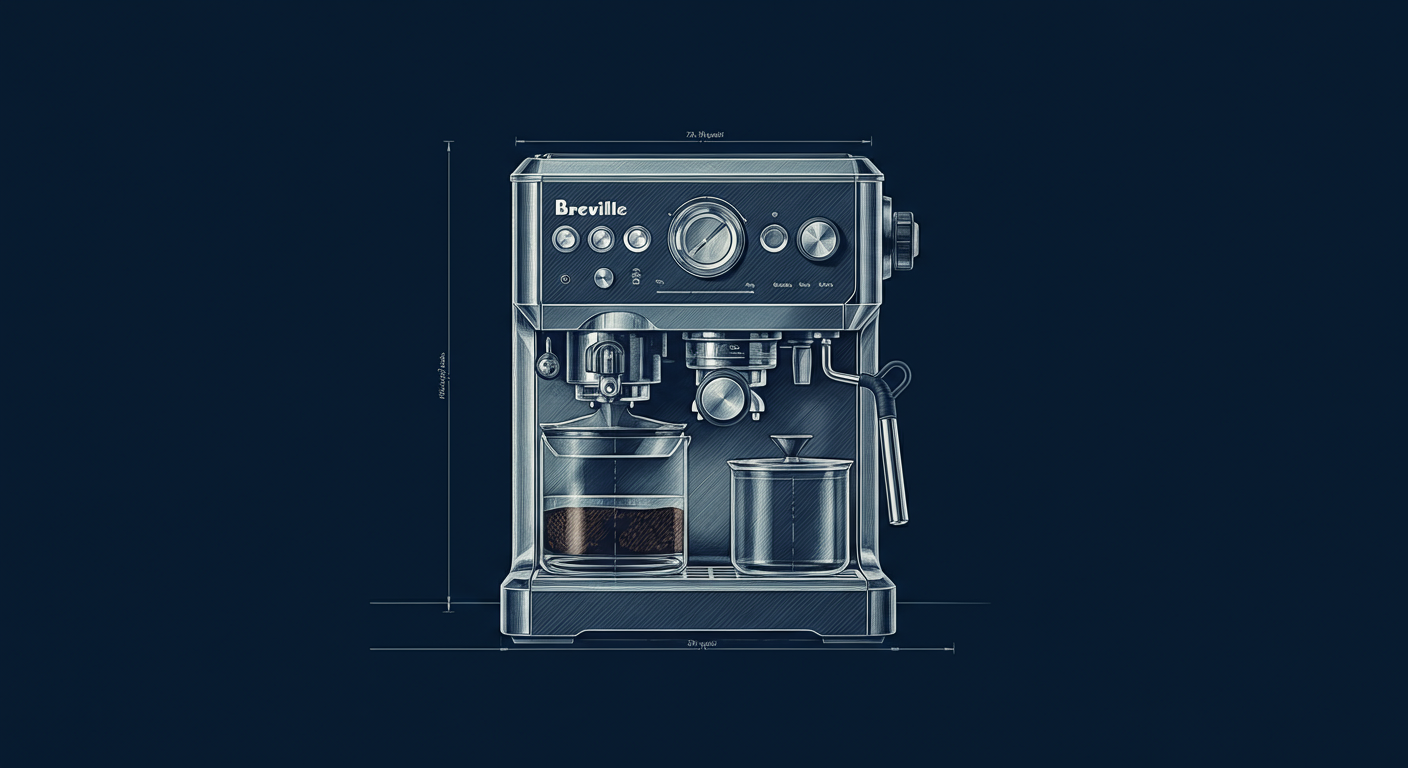
The Breville Barista Express, designated as model BES870XL, presents itself as an all-in-one espresso solution. It attempts to package a grinder, brewing system, and steaming apparatus into a single unit. This integration is its primary selling point. It is also its primary weakness. The machine is a study in engineering compromises, designed for convenience over precision. Its long-term viability is questionable. Its espresso output is inconsistent. Its primary function is to introduce users to espresso, not to master it.
Spec Audit
| Parameter | Specification |
|---|---|
| Model Designation | Breville Barista Express (BES870XL) |
| Heating System | 1600W Thermocoil (Thermoblock) |
| Pump Type | 15-Bar Italian-designed Ulka Vibratory Pump |
| Pressure Control | Pre-infusion function, OPV (Over Pressure Valve) set to 15 bar (often higher than ideal 9 bar for extraction) |
| Integrated Grinder | Conical burr grinder (stainless steel burrs, significant plastic internal components) |
| Bean Hopper Capacity | 0.5 lbs (227g) |
| Water Tank Capacity | 67 fl. oz (2L) |
| Portafilter Diameter | 54mm (proprietary) |
| Construction Materials | Brushed Stainless Steel exterior; significant ABS plastic internals, particularly in grinder and portafilter handles. |
| Dimensions (W x D x H) | 12.5″ x 12.2″ x 13.1″ (31.8cm x 31cm x 33.3cm) |
| Weight | 23 lbs (10.4 kg) |
| Voltage | 120V |
| Price Range (USD) | $700 – $800 (subject to market fluctuations) |
Observed Performance Indicators
Pros (Acceptable Parameters)
- Integrated system: Consolidates equipment. Reduces counter space footprint. This is a functional convenience, not a performance enhancement.
- Rapid heat-up: Thermoblock achieves operational temperature quickly. Thermal mass is low, however.
- Pressure gauge: Provides visual feedback on pump output. Lacks true utility for extraction pressure control.
- Included accessories: Bundles essential tools (portafilters, tamper, milk jug). Quality is entry-level.
- Cost efficiency: Appears economical compared to separate, higher-grade components. This is an illusion for long-term users.
Cons (Deficiencies and Failures)
- Integrated grinder: The primary defect. Inconsistent particle distribution. Significant retention. Grinding mechanism relies on critical plastic components, ensuring premature wear and catastrophic failure. Not suitable for true espresso fineness or consistency.
- Thermal stability: Thermoblock design inherently lacks thermal mass. Temperature surfing is a requirement for acceptable, not optimal, extraction. Not suitable for consecutive shots without significant temperature drops.
- 54mm Portafilter: Non-standard dimension. Limits aftermarket accessory options. Requires specific dosing and tamping technique.
- Vibratory pump: Louder operation. Less consistent pressure delivery compared to rotary pumps. OPV often factory-set too high.
- Cleaning and maintenance: Integrated grinder is difficult to access for thorough cleaning. Backflushing required.
- Build materials: Exterior is brushed stainless steel. Internal components critical to operation, particularly in the grinder assembly and some plumbing, are ABS plastic. This is a design flaw for longevity.
- Workflow segmentation: Single thermoblock requires sequential operations (brew, then steam). No simultaneous function.
- Durability: The reliance on plastic for critical moving parts, especially within the grinder, guarantees a finite operational lifespan under regular use. This is planned obsolescence.
The 3-Axis Deep Dive
Mass (Build Quality)
The external casing presents as brushed stainless steel. This provides an initial impression of durability. This impression is superficial. Examination of internal components, specifically within the grinding mechanism, reveals extensive use of ABS plastic. The bean hopper itself is plastic. The grinder’s upper burr carrier, the adjustment collar, and key internal drive components are plastic. This material selection is a calculated compromise. It reduces manufacturing cost. It simultaneously introduces points of critical failure. Plastic components are subject to creep, fatigue, and abrasion. They deform under load. They degrade with heat and friction. A system is only as robust as its weakest link. In the Barista Express, the weakest links are plastic.
The portafilter is 54mm, not the standard 58mm. This is a proprietary dimension. It limits compatibility with professional accessories. The plastic handle is another point of potential failure. The overall weight, 23 lbs, is moderate. It indicates some metal chassis, but not a full cast construction. It is a shell. Not a fortress. The build prioritizes aesthetic appearance and manufacturing economy over true mechanical integrity. It does not prioritize component longevity or performance under stress.
Ratio (Value Justification)
The Barista Express is marketed as a complete system. It bundles a grinder, an espresso machine, and a steaming wand. This apparent convenience drives its market acceptance. The retail price, typically $700-$800, seems competitive for this bundled functionality. This perception of value is flawed. The individual components, when assessed against industry standards, are suboptimal. The integrated grinder’s performance is below that of a dedicated entry-level grinder. Its particle distribution is inconsistent. This directly impacts extraction quality. The thermoblock heating system, while fast, lacks the thermal stability of a boiler system. This compromises shot consistency. The vibratory pump, while functional, is not as robust or quiet as a rotary pump.
The long-term cost equation is also critical. The reliance on internal plastic grinder components guarantees a reduced lifespan. Replacement parts for the grinder are common service items. A user will face either repair costs or full unit replacement. This negates initial perceived savings. Furthermore, the machine’s inherent limitations often lead to upgrade cycles. Users will seek better grinders or machines once their skill develops. This makes the initial investment a temporary solution. True value resides in sustained performance and longevity. This machine offers neither to an acceptable degree for a discerning user. It is a gateway drug, not a primary residence. The initial lower cost is offset by future repair and replacement expenditures, or the inevitable upgrade cost to a more capable system.
Time (Workflow Efficiency)
The workflow of the Barista Express is sequential, not parallel. This is a direct consequence of its single thermoblock design. The machine must heat up for brewing. Then, it must purge and reheat to steam temperature. Then, it must purge again to return to brewing temperature. This cycle introduces significant delays. It disrupts fluid operation. Batch preparation, for multiple milk-based drinks, is inefficient. The heat-up time itself is rapid, due to the thermoblock’s low thermal mass. This is deceptive. The subsequent temperature stabilization and recovery between shots is slow. This impacts shot consistency during high-volume use or back-to-back extractions. It is a bottleneck.
Grinding operations are also a time sink. The integrated grinder is messy. Static retention is common. Cleaning the grinder is arduous. Regular purging of stale beans from the grinder is necessary to mitigate quality degradation. This consumes time and coffee. The proprietary 54mm portafilter requires specific dosing and tamping care. Inconsistent tamping or dosing will exacerbate the machine’s other limitations. The water tank capacity is adequate. The drip tray requires frequent emptying. Overall, the workflow is acceptable for a single, occasional beverage. It is inefficient and frustrating for dedicated daily use or entertaining. It demands patience. It does not reward efficiency.
The Flaw Investigation: Integrated Grinder Durability
The integrated grinder is the machine’s Achilles’ heel. Breville utilizes stainless steel conical burrs. This is an acceptable material for the grinding surface. However, the critical supporting and adjustment components are predominantly injection-molded ABS plastic. This includes the upper burr carrier, the grind size adjustment collar, and internal mechanisms connecting the burrs to the drive motor. This material selection represents a fundamental design vulnerability. It is not an oversight. It is an engineering choice with predictable consequences.
Plastic, specifically ABS, possesses lower tensile strength and modulus of elasticity compared to metal. It is susceptible to thermal degradation. Grinding coffee beans generates both friction and heat. This thermal load, combined with mechanical stress from the burrs, initiates a process of material creep and fatigue in the plastic components. Over time, the plastic burr carrier will deform. This deformation leads to burr misalignment. Misalignment directly impacts particle distribution. Inconsistent particle size is detrimental to espresso extraction. It results in channeling and uneven flavor profiles. The machine cannot produce high-quality espresso if its particle output is compromised.
The grind adjustment mechanism, also largely plastic, suffers similar issues. Constant adjustment, particularly under load or with finer settings, places stress on these plastic threads and gears. They wear down. They strip. Precise, repeatable grind adjustments become impossible. The motor’s torque is transmitted through these plastic components. They are not engineered for long-term stress cycling. Eventual failure is inevitable. This manifests as the grinder seizing, inability to adjust grind size, or catastrophic gear stripping. The lifespan of these components is directly proportional to usage frequency and the fineness of the grind settings typically employed. Finer grinds increase stress. Espresso requires fine grinds. This creates a self-defeating cycle.
Repairability is a further concern. Accessing these internal grinder components requires significant disassembly. Replacement parts, if available, often suffer from the same inherent material limitations. This means a recurring issue. The cost and effort of such repairs often approach a significant fraction of the machine’s original purchase price. This renders the machine a disposable appliance. It is a planned obsolescence. The design ensures that the most frequently used and mechanically stressed component will fail first, necessitating unit replacement or expensive, temporary repair.
The retention of ground coffee within the plastic chute and burr housing is also notable. Plastic surfaces exhibit higher static cling than metal. This exacerbates retention. Stale coffee grounds accumulate. They compromise the flavor of subsequent extractions. Cleaning the integrated grinder is cumbersome. It cannot be easily detached or fully disassembled by the user for comprehensive cleaning. This further contributes to the degradation of both the machine and the coffee quality over time. The grinder is not merely inadequate in performance; it is fundamentally flawed in its material engineering for its intended purpose. Its internal plastic structure is a temporal fuse, set to expire.
Comparative Analysis: Breville Barista Express vs. Gaggia Classic Pro + Baratza Encore ESP
To accurately assess the Barista Express, a comparison to a modular setup is imperative. Consider the Gaggia Classic Pro (GCP) paired with a dedicated grinder, such as the Baratza Encore ESP. This configuration offers insight into where the Barista Express compromises.
Gaggia Classic Pro (Espresso Machine)
- Heating System: Single boiler. Provides superior thermal stability compared to a thermoblock. Boiler has greater thermal mass. Allows for more consistent shot temperature.
- Portafilter: Standard 58mm. Allows for broad compatibility with professional-grade accessories (baskets, tampers, WDT tools).
- Pump: Vibratory pump, but often allows for easier OPV modification for lower, espresso-optimal pressure.
- Build: Primarily stainless steel and brass components. Significantly more robust and repairable. Designed for longevity.
- Workflow: Still single boiler, requiring temperature surfing. However, dedicated PID mods are common and effective, offering superior control.
Baratza Encore ESP (Grinder)
- Grinding Mechanism: Dedicated M2 conical burr set. Designed for espresso particle distribution.
- Materials: Robust plastic and metal construction. Engineered for higher durability than the integrated Breville grinder. Key internal components are more robust.
- Retention: Significantly lower retention than the Breville’s integrated unit. Easier to clean.
- Adjustability: More precise and repeatable grind adjustments, specifically engineered for espresso. External grind adjustment mechanism is durable.
- Repairability: Baratza is known for readily available parts and user-serviceability. This extends product lifespan.
The Contrast
The combined cost of a Gaggia Classic Pro and a Baratza Encore ESP typically sits in a similar price bracket to the Barista Express. The Gaggia + Baratza setup, while requiring more counter space, delivers fundamentally superior performance in two critical areas: grinding and thermal stability. The GCP’s boiler ensures more stable brewing temperatures. The Encore ESP provides a significantly more consistent and appropriate particle distribution for espresso. This directly translates to higher quality, more consistent espresso extractions.
Furthermore, the modular nature provides resilience. If the grinder fails, only the grinder needs replacement. If the espresso machine fails, only the machine. This allows for targeted upgrades and repairs. In the Barista Express, a single critical component failure, like the integrated grinder, can render the entire unit non-functional or economically unrepairable. The combined modular system offers better long-term value, superior performance, and enhanced repairability. The Barista Express sacrifices all these for the illusion of convenience and a lower initial perceived cost. This is a false economy. It is a short-term solution with long-term liabilities.
Final Judgment
The Breville Barista Express is an entry-level appliance. It functions. It produces a beverage resembling espresso. It provides integrated convenience. These are its only merits. Its fundamental design flaws prohibit it from achieving consistent, high-quality espresso. The integrated grinder’s internal plastic components are a significant point of failure. This is not a matter of “if” but “when” they will degrade or fail, leading to inconsistent particle distribution or total grinder cessation. This design decision exemplifies planned obsolescence. The thermoblock heating system delivers acceptable temperature quickly but lacks the thermal stability required for consistent extraction, especially across multiple shots.
The machine is suitable for a user whose primary requirement is a single-button approach to coffee-flavored hot water. It is for those who prioritize counter space over extraction quality. It is for those who are unwilling or unable to invest in dedicated, high-performance components. For any user serious about espresso quality, consistency, or long-term durability, the Barista Express represents a compromise that will inevitably lead to frustration and a desire for upgrade. It is a starter kit, a proof-of-concept for personal espresso production. It is not an instrument of precision. It is not an investment in sustained coffee excellence. It is a stepping stone. A stepping stone to a better, more robust system, purchased after its inherent limitations become undeniable. It exists. It underperforms. It fails.
Breville Barista Express Espresso Machine
Audited by The Chief Auditor
*Commission earned