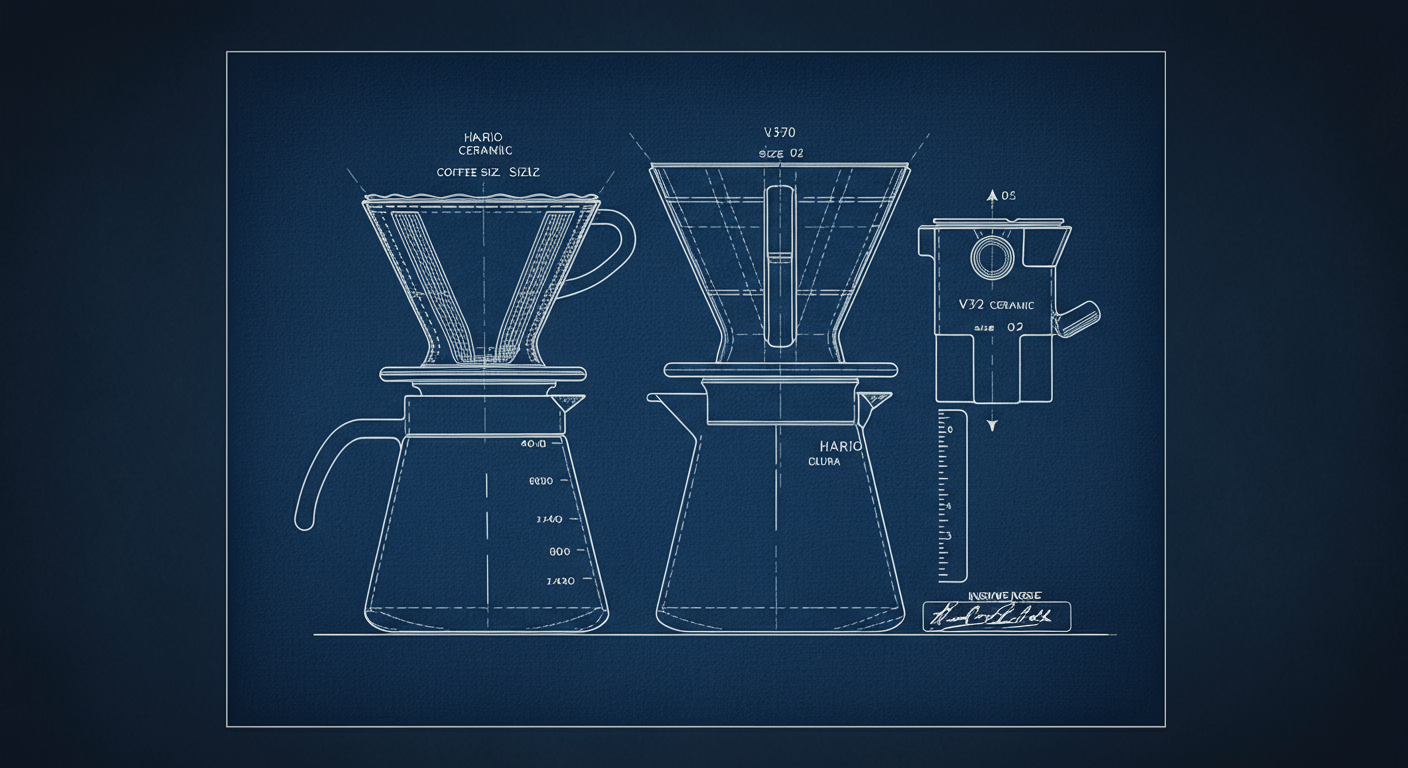
The Hario V60 Ceramic Dripper, Size 02, represents a static point in manual brewing technology. It performs its primary function. Its design principles are established. It demands user precision. Its material choice introduces inherent fragility. It is not groundbreaking. It is merely present. Claims of its “iconic” status are irrelevant to its functional performance. It is a conduit. Nothing more, nothing less. Operators must understand its limitations and compensate with rigorous technique. Failure to do so will result in sub-optimal extraction kinetics.
Spec Audit
| Parameter | Specification | Audit Status |
|---|---|---|
| Material Composition | High-fired Porcelain Ceramic | Acceptable. Provides thermal mass. |
| Nominal Dimensions (LxWxH) | 115mm x 100mm x 82mm (approximate, manufacturer stated) | Consistent with observed units. |
| Operational Weight | ~360 grams (unloaded) | Provides stability. Implies material density. |
| Capacity Rating | 1-4 Cups (Size 02) | Refers to volumetric output, not input. Consistent with filtration area. |
| Filter Interface | Hario V60 Conical Paper Filter | Proprietary consumable dependency confirmed. |
| Drain Hole Diameter | 25mm (approximate) | Critical variable. Subject to manufacturing tolerance. |
| Internal Geometry | Conical, spiral rib structure | Functionally designed for air channel. Requires consistent execution. |
| Thermal Property | High Thermal Mass (Ceramic) | Advantage for temperature stability. Disadvantage for preheating energy. |
| Origin of Manufacture | Japan | Geographic indicator. Quality control protocols are assumed. |
Pros & Cons
-
Pros:
- **Thermal Stability:** Ceramic retains heat effectively. This minimizes temperature drop during the extraction phase, assuming adequate preheating. Physics mandates stable thermal environments for consistent solubility.
- **Chemical Inertness:** Porcelain ceramic is non-reactive. It does not impart off-flavors to the brew, unlike certain plastics or reactive metals. Material science validates this.
- **Geometric Consistency (Ideal):** The conical form factor, when precisely manufactured, facilitates a deep bed depth, promoting uniform extraction with ideal grind distribution.
- **Aesthetic Integration:** Its visual form is widely recognized. This is irrelevant to performance but noted for completeness regarding market perception.
-
Cons:
- **Inherent Fragility:** Ceramic is brittle. Susceptible to impact fracture. Thermal shock can induce microfractures. This is a fundamental material limitation, not a design oversight. It will break.
- **Preheating Requirement:** High thermal mass necessitates significant energy and time expenditure for preheating. Failure to achieve thermal equilibrium will result in substantial heat loss from the slurry, negatively impacting extraction efficiency.
- **Operator Skill Dependency:** The large drain hole and open conical design are highly sensitive to pouring technique, grind consistency, and bloom management. It is not an automated system. It amplifies user error.
- **Filter Consumable Lock-in:** Requires specific Hario V60 conical paper filters. This represents a recurring cost and a point of proprietary dependency.
- **Manufacturing Inconsistencies:** The ceramic firing process can introduce subtle but functionally significant deviations in internal rib geometry and drain hole concentricity. These flaws compromise performance.
- **Thermal Shock Potential:** Rapid temperature changes can stress the ceramic matrix, potentially leading to cracking over prolonged use.
The 3-Axis Deep Dive
1. Mass (Build Quality)
The Hario V60 dripper, in its ceramic iteration, is fundamentally a mass-centric device. Its approximately 360-gram unladen mass is directly attributable to its porcelain ceramic construction. This mass serves a singular, primary function: thermal regulation. Ceramic possesses a high specific heat capacity. This property dictates that a significant quantity of energy is required to elevate its temperature, and once achieved, that temperature is maintained with minimal fluctuation during the brief brewing cycle. This thermal inertia is beneficial for preserving the thermodynamic stability of the coffee slurry. A stable slurry temperature promotes consistent kinetics of solubles extraction.
However, the material science of porcelain ceramic presents significant counterpoints. While chemically inert and robust against chemical degradation, it exhibits low tensile strength. This renders the device highly susceptible to impact-induced fracture. A drop from a typical counter height is a terminal event. Furthermore, while resistant to heat, ceramic is vulnerable to thermal shock. Rapid heating or cooling cycles can induce internal stresses within the material matrix, potentially leading to microfractures that compromise structural integrity over time. The manufacturing process itself, involving high-temperature firing, introduces variables related to material shrinkage and potential deformation. These variables directly impact the final geometric precision of critical features such as the internal ribs and the drain aperture.
The build quality, therefore, is a dichotomy. It is solid in its thermal function but inherently fragile in its mechanical properties. The single-piece molded construction, encompassing the cone and the handle, eliminates weak points often associated with multi-component assemblies. This is an engineering advantage. However, the integrity of the glaze, a superficial but critical layer, must also be considered. A uniform, non-crazed glaze prevents coffee oils and particulates from permeating the porous ceramic substrate, maintaining hygiene and preventing off-flavors. Any defect in the glazing process is a direct compromise of the device’s long-term utility. The V60 is built to contain, transfer heat, and facilitate flow. It is not built to endure kinetic abuse.
2. Ratio (Value)
Assessing the value (Ratio) of the ceramic Hario V60 requires an evaluation beyond its mere purchase price. Its cost is moderate for a ceramic pour-over device. The return on this investment is largely contingent upon the operator. The V60 is a passive instrument. It does not actively enhance extraction or compensate for deficiencies in grind consistency, water quality, or pouring technique. Its value is derived from its capacity to consistently provide a stable platform for *optimal* manual brewing, assuming the operator supplies all necessary variables with precision. It offers no inherent automation or error correction.
The ceramic V60’s primary value proposition over its plastic counterpart is its superior thermal mass. This translates to a more stable brewing environment, which, from a physics perspective, is advantageous for repeatable extraction. However, this thermal advantage comes with a fragility penalty. The decision to invest in ceramic over a more durable, less thermally stable plastic version is a trade-off: thermal performance versus mechanical resilience. The plastic version is demonstrably more cost-effective at acquisition and less prone to catastrophic failure. The glass version occupies a similar thermal niche but often at a higher price point and with comparable fragility.
Furthermore, the V60 system is not a standalone purchase. It necessitates the continuous acquisition of proprietary conical paper filters. These filters are not a trivial cost over the lifetime of the device. This recurring expense must be factored into the overall value equation. The dripper’s value, therefore, is tied to its functional ecosystem. A low initial cost for the dripper itself might appear favorable, but the cumulative expense of its consumables degrades this perceived value. The longevity of the ceramic V60, assuming proper handling, can be indefinite. However, its fragility ensures that a single moment of carelessness can render the entire investment null. The value is present, but conditional.
3. Time (Workflow)
The Hario V60, regardless of material, is not designed for expedience. It is a device that inherently demands time. This is a direct consequence of its manual operation protocol. The first and most critical time expenditure is the preheating phase. Due to ceramic’s high thermal mass, significant thermal energy must be transferred to the dripper prior to brewing. This requires several minutes and a substantial volume of hot water. Neglecting this step introduces a critical variable into the extraction process, as the dripper will draw heat from the brew slurry, resulting in an immediate and detrimental temperature drop. This is a direct time cost that cannot be circumvented without consequence.
The actual brewing process is also time-intensive. Manual pour-over requires continuous, controlled water application. This is not a “set and forget” operation. The operator must manage pour rate, pattern, and volume to ensure uniform saturation and prevent channeling. This demands active engagement for the entire 2-4 minute brewing cycle. The V60’s large single drain hole and spiral ribs encourage a relatively fast drawdown, but this speed is highly dependent on grind consistency and the operator’s ability to maintain an even bed and prevent fines migration. Inconsistent grind distribution, specifically an excessive amount of fines, can lead to choking or inconsistent flow, thereby extending extraction time unpredictably or compromising the extraction profile.
Post-brew workflow is relatively efficient. The ceramic surface is non-porous and easy to rinse clean. Chemical inertness prevents residual odors or staining, simplifying maintenance. However, the overall “time-cost” for achieving an acceptable brew with the V60 is significantly higher than with automated drip machines or even simpler immersion brewers. It is a tool for precision and deliberate execution, not for rushed morning routines. The learning curve for consistent performance adds an initial, significant time investment in skill development. This device does not save time; it appropriates it for the pursuit of extraction control.
The Flaw Investigation: Internal Spiral Ribs and Drain Hole
The functional efficacy of the Hario V60 dripper hinges entirely on the precise execution and integrity of its internal geometry, specifically the spiral ribs and the singular drain hole. These are not merely aesthetic features; they are critical engineering components dictating fluid dynamics and airflow within the brew chamber. Manufacturing flaws in these areas directly compromise the device’s ability to deliver consistent and controlled extraction.
Internal Spiral Ribs:
The internal spiral ribs serve two primary, physics-based functions. First, they create a series of discrete air channels between the filter paper and the ceramic wall. This prevents the formation of a vacuum seal, which would otherwise impede drawdown and prevent effective degasification during brewing. Second, they act as spacers, preventing the filter paper from collapsing entirely against the dripper wall, thus influencing the overall flow rate and promoting an even saturation of the coffee bed by allowing water to move across the filter surface, not just through its center. Their geometry is paramount.
**Consistency Audit:** The consistency of these ribs must be rigorously verified. Any deviation from the intended profile—uneven height, inconsistent spacing, or incomplete molding—will directly alter the airflow dynamics. If ribs are too shallow or absent in sections, the filter paper can adhere too tightly, restricting flow and leading to over-extraction in those areas. Conversely, if ribs are too pronounced or irregular, they can create preferential flow paths or channels along the wall, leading to bypass and under-extraction. The ceramic firing process, which involves material shrinkage, poses a significant challenge to maintaining uniform rib geometry across all manufactured units. A quantitative measurement of rib height and periodicity, perhaps via laser profilometry, would be necessary to ensure compliance with design specifications. Manual visual inspection is insufficient for detecting subtle, yet functionally critical, deviations.
**Integrity Audit:** Beyond consistency, the integrity of the rib surfaces is crucial. The ribs must be continuous, smooth, and free from chips, cracks, or surface imperfections. A rough or discontinuous rib can snag or tear the delicate paper filter, compromising its structural integrity during brewing. Furthermore, any surface irregularity can introduce micro-turbulence into the fluid flow, subtly altering extraction patterns. Glaze application is also critical here; the ribs must be uniformly glazed. An uneven glaze thickness can subtly change the rib’s effective profile, and un-glazed sections can become porous, absorbing coffee oils and becoming a vector for residual flavors, compromising the chemical inertness of the device.
Drain Hole:
The singular drain hole at the apex of the V60 cone is the primary determinant of flow rate and, consequently, contact time between water and coffee. Its geometric properties—diameter, concentricity, and edge finish—are absolute critical control points for repeatable extraction.
**Diameter Consistency:** The diameter of the drain hole is the most direct control over the rate of effluent flow under a given hydrostatic pressure. Any deviation from the specified diameter directly impacts drawdown time. A hole marginally smaller than specification will restrict flow, prolonging contact time and risking over-extraction. Conversely, a larger hole will accelerate flow, potentially leading to under-extraction. Batch-to-batch consistency in this parameter is non-negotiable for reproducible brewing recipes. Measurement with calibrated calipers is the minimum standard; however, the irregular nature of ceramic and potential post-firing deformations make achieving perfect consistency challenging.
**Concentricity:** The drain hole must be perfectly centered at the conical apex. An off-center drain hole introduces an asymmetry into the brew bed. Hydrostatic pressure, acting evenly across the coffee bed, will then preferentially push water towards the closest edge of the off-center aperture. This creates uneven flow paths, promotes channeling, and leads to an imbalanced extraction. The result is a cup profile that lacks uniformity and clarity. Visual inspection, even with magnification, is often insufficient to detect subtle concentricity errors that can significantly impact flow dynamics. Precision jigging during manufacture and post-firing verification are necessary.
**Edge Finish:** The edges of the drain hole must be smooth, clean, and free of burrs, chips, or residual ceramic material. Rough edges can create micro-turbulence, impeding laminar flow and potentially leading to accumulation of fines, which can restrict the flow path over time. A sharp, well-defined aperture is critical for predictable fluid dynamics. Glaze integrity around the drain hole is also crucial to prevent absorption and ensure ease of cleaning.
Implications of Flaws:
Manufacturing flaws in either the ribs or the drain hole are not cosmetic imperfections; they are functional defects. They transform the V60 from a precision instrument into an uncontrolled variable. Inconsistent rib geometry leads to unpredictable resistance against the filter paper, disrupting flow. A defective drain hole geometry leads to uncontrolled drawdown rates. Both scenarios compromise the integrity of the extraction process, leading to inconsistent cup quality, batch to batch. The device ceases to be a reliable component in a controlled brewing system. Its market prevalence does not negate the necessity for rigorous manufacturing quality control. Without it, the “V60 experience” becomes entirely dependent on the lottery of individual unit quality, an unacceptable variable in any audited system.
Comparison: Hario V60 Ceramic vs. Kalita Wave 185 (Ceramic/Stainless Steel)
To provide context, a comparative analysis against a direct competitor, the Kalita Wave 185, is necessary. Both are manual pour-over drippers, but their design philosophies and resultant brew characteristics diverge significantly.
The Hario V60, specifically the ceramic 02, features a steep conical geometry, a large single drain hole, and prominent spiral ribs. Its design prioritizes unrestricted flow. This characteristic mandates a high degree of operator control over all brewing variables: grind particle distribution, water temperature, pour rate, and agitation. The V60 is notoriously unforgiving. Its large drain hole allows for rapid drawdown if not managed correctly, leading to under-extraction and an underdeveloped flavor profile. Conversely, a fine grind or an uncontrolled pour can choke the single drain hole, leading to over-extraction and bitterness. The spiral ribs, as previously discussed, are crucial for air release and preventing filter collapse, maintaining the high flow rate potential. The V60 is a tool engineered for precision, demanding expert execution to realize its full potential for clarity and nuanced flavor profiles. Its thermal stability (in ceramic form) contributes to repeatable extraction kinetics, provided preheating is executed rigorously.
The Kalita Wave 185, in contrast, employs a flat-bottomed geometry with three smaller drain holes. This design fundamentally alters the physics of fluid flow through the coffee bed. The flat bed promotes a more uniform depth of coffee, theoretically leading to more even saturation across the entire bed. The three smaller drain holes, and their cumulative orifice area, create a more restrictive flow environment compared to the V60’s single large hole. This restriction acts as a buffer against operator inconsistency. It makes the Kalita Wave less sensitive to precise pour patterns and grind variations. Channeling, while not entirely eliminated, is less prevalent than in the V60 due to the distributed drainage. The Wave’s design philosophy prioritizes ease of use and consistency of output, even with less skilled operators. It tends to produce a more balanced, full-bodied cup, often sacrificing some of the intricate clarity achievable by an expert V60 brewer for overall approachability. Its thermal properties (in ceramic form) are comparable to the V60, while the stainless steel version offers superior durability at the cost of thermal mass and rapid preheating.
In summary, the V60 is a high-performance instrument for a skilled artisan, offering superior control and the potential for a highly articulate cup profile, but with significant risk of operator error. The Kalita Wave is a more robust, forgiving system, designed for broader accessibility and consistent, if less singularly outstanding, results. Neither is objectively “better”; their utility is context-dependent, aligning with either the pursuit of absolute control or reliable reproducibility with reduced effort. The V60 requires the user to compensate for its inherent lack of restriction, while the Wave incorporates restriction into its design.
Final Judgment
The Hario V60 Ceramic Dripper 02 functions. Its conical design and large drain aperture are based on established fluid dynamics principles. Its ceramic construction provides measurable thermal stability, a definite advantage over less inert or thermally responsive materials, albeit at the cost of mechanical durability. The manufacturing consistency of its critical features, specifically the internal spiral ribs and the drain hole, is paramount for repeatable results. Any deviation from specified geometry in these areas directly degrades its performance from a precision instrument to a variable component. The device does not possess inherent intelligence or error correction. It will not compensate for a poorly calibrated grinder, inconsistent water temperature, or haphazard pouring technique. Its perceived “excellence” in brewing output is, in almost all cases, a direct reflection of the operator’s meticulous adherence to strict brewing protocols, rather than an intrinsic, unparalleled capability of the device itself. It is a tool. It is not an automated system. For manual brew protocols demanding high user engagement and precise operator control, it remains an acceptable option. However, its fragility and demanding nature preclude it from being a universal recommendation for all user profiles or operational environments.
Hario V60 Ceramic Coffee Dripper, Size 02
Audited by The Chief Auditor
*Commission earned