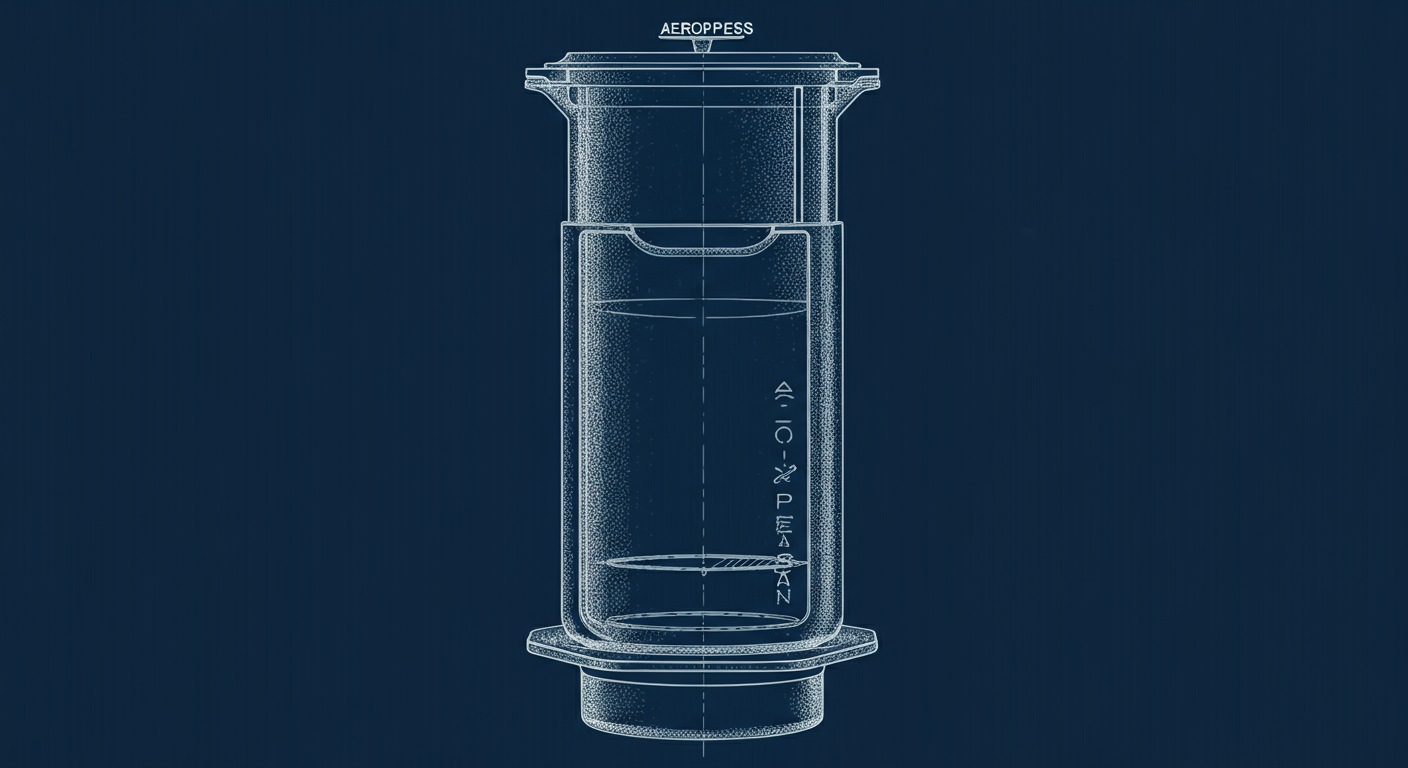
The AeroPress Original. A plastic cylinder, a TPE plunger. It brews coffee. Do not expect miracles. Do not accept marketing hype. This device produces a coffee concentrate. It is not an “espresso maker.” That nomenclature is a marketing deception. It functions. It generates sufficient pressure for filtration, not for true espresso extraction. Its global demand score is high, a testament to effective branding and accessible pricing, not necessarily engineering superiority. This audit will dissect its claims and performance with unyielding scrutiny.
Spec Audit
| Parameter | Specification (Claimed/Observed) | Audit Commentary |
|---|---|---|
| Material Composition | Chamber/Plunger: Polypropylene; Seal: Thermoplastic Elastomer (TPE) | Plastic. Not inert in all contexts. Heat cycles will induce predictable material stress. Not a durable good in the traditional sense. |
| Filter Type | Proprietary Paper Microfilters (x350 included); Aftermarket metal filters available. | Microfilters effectively block fines, producing a clean cup. Requires specific, ongoing supply. Aftermarket solutions alter particulate retention characteristics. |
| Brew Volume (Nominal) | 1-3 servings (concentrate, not finished beverage volume) | Output is a concentrate. Requires dilution. Not a direct single-serve drip coffee replacement. Capacity is fundamentally limited. |
| Operating Pressure (Estimated) | 0.3 to 0.7 bar (User-generated manual force) | Significantly below authentic espresso extraction pressures (>9 bar). The “espresso” descriptor is therefore a misrepresentation of capability. |
| Brew Time (Typical) | 10 seconds to 2 minutes (variable by technique and grind size) | Rapid. Dependent on grind consistency, water temperature, and user exertion. Achieves fast extraction for concentrate. |
| Dimensions (Approx.) | Height: 12.5 cm; Diameter: 10 cm | Compact. Promotes portability. Occupies minimal counter space. |
| Weight (Approx.) | 200g (without accessories) | Lightweight. Directly attributable to plastic construction. Lacks thermal mass. |
| Claimed Features | “Espresso Style Coffee”, “Full Immersion”, “Rapid Brewing” | “Espresso Style” is marketing terminology, not an engineering specification. “Full Immersion” is accurate. “Rapid Brewing” is achievable. |
| Included Accessories | Stirrer, Scoop, Filter Holder, 350 Filters | Minimal operational kit. Sufficient for immediate function. Does not add significant value. |
Pros & Cons
Acceptable Attributes
- **Speed of Extraction:** Short contact times are demonstrably achievable. Suitable for rapid concentrate production, reducing wait times.
- **Filtration Efficacy:** Paper microfilters effectively mitigate particulate matter. The resulting beverage exhibits a clean, low-turbidity profile.
- **Cleaning Protocol:** Expelling the spent coffee puck is efficient and generally clean. This minimizes daily maintenance time and effort.
- **Physical Dimensions:** The compact form factor facilitates portability and reduces counter footprint. Acceptable for restricted environments.
- **Methodological Flexibility:** Accommodates a broad range of grind sizes and water temperatures. Supports diverse brewing techniques, including cold concentrate.
- **Acquisition Cost:** The initial investment is low. This provides a low barrier to entry for the general consumer market.
Deficient Attributes
- **Material Integrity:** Primary construction is polymer-based. Polypropylene is subject to thermal degradation, staining from coffee oils, and potential stress cracking over time. Not a permanent asset.
- **Thermal Stability:** Minimal thermal mass. Brew water temperature will inevitably decrease rapidly within the chamber. This compromises extraction consistency.
- **Capacity Limitation:** Designed explicitly for single-serve concentrate production. Inefficient and cumbersome for preparing multiple servings concurrently.
- **”Espresso” Misnomer:** The device fundamentally lacks the pressure generation capability required for authentic espresso. The terminology is inaccurate and misleading.
- **Plunger Seal Longevity:** The TPE seal is a known wear component. Degradation and fitment issues are predictable and necessitate periodic replacement.
- **Filter Dependency:** Relies on proprietary paper filters. These represent an ongoing consumable cost. Aftermarket metal filters alter the filtration characteristics, often introducing fines.
- **Manual Exertion:** The pressing action requires significant user force. This is not universally ergonomic and can be physically challenging for some users.
- **Off-Gassing/Taste Impartation:** New units can exhibit a discernible plastic odor. This implies potential for initial taste contamination, which typically dissipates.
The 3-Axis Deep Dive
Mass: The Material Imperative (Build Quality)
The AeroPress Original is a polymer composite. Its primary constituents are polypropylene for the brew chamber and plunger, with a thermoplastic elastomer (TPE) for the critical sealing element. This is not a solid-state, precision-machined instrument. This is injection-molded plastic. The direct consequence of this material selection is low mass, approximately 200 grams. This contributes to its lauded portability. It simultaneously guarantees poor thermal retention properties.
Polypropylene possesses a low thermal mass. When hot water is introduced into the chamber, a rapid and significant thermal exchange occurs between the water and the cooler plastic. This results in an immediate and quantifiable drop in brew water temperature. This temperature instability directly impacts extraction kinetics. Consistent and repeatable extraction profiles become inherently difficult to achieve, demanding precise control of initial water temperature and minimal immersion time to mitigate the thermal decay. The material itself is a variable in the extraction equation.
Material durability, for a plastic device, is acceptable. It exhibits resistance to blunt impact. It is not resistant to all forms of degradation. Prolonged exposure to high temperatures, cyclic thermal stress, and interaction with coffee oils will inevitably lead to material fatigue. Micro-fractures, discoloration, and surface degradation are observed phenomena over extended operational periods. While advertised as “BPA-free,” this singular chemical exclusion does not render the material perfectly inert or impervious to all forms of chemical interaction or aging. Its useful lifespan is finite, determined by cumulative stress. It is a utility item, not a durable good designed for generational use.
Ratio: Performance per Monetary Unit (Value)
The acquisition cost of the AeroPress is demonstrably low. This positions it as an accessible brewing apparatus. Evaluating its value requires an objective assessment of its actual performance versus its advertised capabilities. It reliably produces a filtered coffee concentrate. This function is executed efficiently for its price point.
The persistent marketing of “espresso-style coffee” demands direct rebuttal. True espresso requires sustained pressure of 9 bars or more. The AeroPress, relying on manual user exertion, generates a peak pressure in the range of 0.3 to 0.7 bar. This is a disparity of over an order of magnitude. Therefore, any claim of “espresso” is fundamentally unsubstantiated by physical principles. The monetary investment does not procure espresso capability. It procures a device for pressurized immersion brewing, resulting in a concentrate.
Consumables, primarily the proprietary paper microfilters, represent an ongoing expenditure. While the per-filter cost is minimal, the cumulative cost can become significant over years of daily use. The value assessment must incorporate this recurring cost. Aftermarket metal filters exist to eliminate this, but they fundamentally alter the filtration profile, allowing more fines into the beverage, thereby changing the cup character. This compromises the “clean cup” advantage of the paper filter system.
Considering its actual core function – the production of a rapid, clean, single-serve coffee concentrate – the AeroPress offers acceptable value. Its versatility in accommodating varied grind sizes, temperatures, and immersion times further contributes to this perceived value. However, this value is contingent upon accurate consumer expectations, divested of marketing hyperbole. The ratio of cost to actual performance is acceptable for its specific, delimited functionality.
Time: The Workflow Equation (Efficiency)
The perceived efficiency of the AeroPress is a primary driver of its adoption. The brewing process from water pour to finished press can indeed be completed in under two minutes. This is a tangible time saving compared to traditional drip brewers or extended immersion methods like the French Press.
However, an audit of the total workflow reveals additional time expenditures. Preheating water is a prerequisite. Grinding beans to the appropriate consistency adds another phase. The device is inherently single-serve. For situations requiring multiple servings, the workflow becomes a repetitive, sequential process of preparation, brewing, and cleaning for each individual cup. This iterative action negates much of the perceived time advantage for multi-person households or office environments. Batch brewing is not a native capability.
Post-brew cleaning is comparatively swift. The spent coffee puck is typically ejected as a solid cylinder, leaving minimal residue within the chamber. A rapid rinse is often sufficient for daily maintenance. This efficiency in cleanup significantly reduces the post-brewing time commitment, a distinct advantage over more complex brewing apparatus with multiple components or mesh filters prone to clogging.
The workflow is entirely manual. It requires continuous user engagement and input. It is not an automated system. For enthusiasts who derive satisfaction from manual brewing, this engagement is not a deficit. For users prioritizing absolute speed and minimal interaction, the manual process introduces a friction point. The “Time” axis rates as acceptable for focused, single-serve preparation but inefficient for scaled production or passive brewing scenarios.
The Flaw Investigation: Plunger Seal Degradation
The Thermoplastic Elastomer (TPE) plunger seal is the singular critical component ensuring the operational integrity of the AeroPress. It is a wear item. Its degradation is an intrinsic material characteristic, not a potential defect. Physics dictates that all polymers, especially under cyclical stress, will exhibit finite lifespans. The TPE seal is subject to multiple, cumulative degradation mechanisms:
- **Compression Set:** Prolonged storage with the plunger inserted and compressed within the brew chamber induces viscoelastic creep. The TPE material, under constant compressive stress, will deform permanently, losing its original elastic memory. This directly compromises the seal’s ability to create a tight, uniform pressure boundary during operation.
- **Thermal Cycling:** The seal experiences repeated exposure to elevated brewing temperatures (typically 80-95°C) followed by cooling to ambient. This thermal cycling induces repeated expansion and contraction at a molecular level. This accelerates polymer chain fatigue, leading to hardening, loss of elasticity, surface cracking, and potentially softening or stickiness.
- **Chemical Exposure:** The TPE material is in direct contact with hot coffee, which contains various acids, oils, and organic compounds. While TPE is generally resistant, cumulative exposure can cause surface interactions, leading to discoloration, changes in material texture, and potential degradation of mechanical properties. Cleaning agents, particularly harsh or abrasive detergents, can exacerbate this chemical attack.
- **Mechanical Abrasion:** Each pressing cycle involves frictional contact between the TPE seal and the internal surface of the polypropylene brew chamber. This repetitive mechanical wear gradually abrades the seal’s surface, reducing its effective diameter and creating micro-channels for pressure bypass.
- **Material Aging:** TPE, like all polymers, undergoes natural aging processes. These include oxidation, UV degradation (if exposed), and other environmental factors that intrinsically limit the material’s service life, regardless of active use.
The observable consequences of seal degradation are significant and functionally impairing. The most common symptom is a reduction in resistance during the pressing phase, often accompanied by audible air or liquid escaping past the seal. This indicates a loss of sealing integrity and a reduction in the effective hydraulic pressure applied to the coffee bed. The immediate result is inconsistent and often under-extracted coffee. Furthermore, a severely degraded seal may allow coffee grounds to bypass it, leading to contamination of the final beverage and mess. In some cases, swelling or stickiness can occur, making the plunger excessively difficult to operate. The fitment issues manifest as either an overly loose or an overly tight plunger action, both detrimental to controlled brewing.
Mitigation efforts can extend the seal’s life but will not prevent its eventual failure. Storing the plunger detached from the chamber significantly reduces compression set. Regular rinsing with water, or using only mild soap, minimizes chemical buildup. However, the TPE seal is a consumable. Its periodic replacement, typically every 1 to 3 years depending on usage frequency and care, is a foreseeable operational expense and a necessary maintenance task for continued optimal performance.
Comparison: AeroPress vs. French Press
A comparative audit against a traditional French Press illuminates the distinct operational and performance characteristics of the AeroPress. Both employ immersion brewing as a core principle. Their divergence in filtration and pressure application yields fundamentally different beverage profiles.
The French Press utilizes a coarse mesh filter and typically a prolonged immersion period, often exceeding four minutes. This method is designed for maximal solubility extraction, producing a coffee often described as full-bodied, rich, and with significant mouthfeel. A characteristic byproduct is the presence of fine particulate matter, or “silt,” which passes through the coarse mesh. This contributes to texture but detracts from cup clarity. Thermal stability in a French Press is primarily governed by the vessel material, often thin glass, which has minimal thermal mass and promotes rapid temperature decay.
The AeroPress, in contrast, integrates immersion with user-generated pneumatic pressure and a fine paper microfilter. The critical distinction is the filtration mechanism. The paper filter effectively traps fine particulates, resulting in a demonstrably cleaner, sediment-free cup profile. The application of pressure accelerates liquid-solid separation, enabling significantly shorter brew times. This expedited extraction, coupled with efficient filtration, typically yields a coffee with lower perceived acidity and bitterness compared to a longer, less filtered immersion method.
Operational practicalities further differentiate the two. French Presses are commonly available in larger capacities (e.g., 1-liter), making them suitable for brewing multiple servings concurrently. The AeroPress is fundamentally a single-serve device, requiring sequential brewing for multiple individuals. Cleaning a French Press, particularly dislodging grounds from the mesh plunger and glass carafe, can be more laborious and messy than the AeroPress’s efficient puck ejection system.
From an auditor’s standpoint, the AeroPress offers a solution to the primary deficiencies of the French Press: particulate contamination and extended brew times. It achieves this through superior filtration and the application of pressure. However, the French Press typically provides a more robust thermal mass (relative to the AeroPress’s plastic) and undeniable multi-serve capability. The selection criteria depend on the user’s priorities: a rapid, clean, single-serve concentrate versus a full-bodied, potentially silty, higher-volume brew.
Final Judgment
The AeroPress Original is a functional coffee apparatus. It is not an engineering triumph, nor does it deliver on all its marketing assertions. Its widespread market penetration confirms its utility, but not necessarily its qualitative supremacy. The claim of “espresso” remains unsubstantiated. The device fundamentally lacks the necessary pressure parameters for authentic espresso extraction. It produces a concentrated coffee beverage.
Its core strengths lie in its capacity for rapid, single-serve brewing and its effective paper microfiltration. This combination yields a clean cup with minimal sediment. Its compact dimensions contribute to its portability. Its low acquisition cost positions it as an accessible entry point into manual brewing.
These advantages are counterbalanced by inherent limitations. The polymer construction restricts its thermal stability and dictates a finite service life. The TPE plunger seal is a known wear item, necessitating periodic replacement – a predictable operational overhead. Its single-serve nature inherently limits its utility for multi-person brewing scenarios. The entirely manual workflow demands consistent user engagement.
For an individual seeking a quick, clean, concentrated coffee solution at a low initial investment, the AeroPress is an acceptable tool. It performs its specific, defined function. It is not a paragon of material science. It is not a durable investment. It is a serviceable, plastic coffee press. User expectations should be rigorously calibrated to its actual capabilities, devoid of promotional embellishments. It is acceptable for its niche. No further commendation is warranted.
AeroPress Original Coffee and Espresso Maker
Audited by The Chief Auditor
*Commission earned